
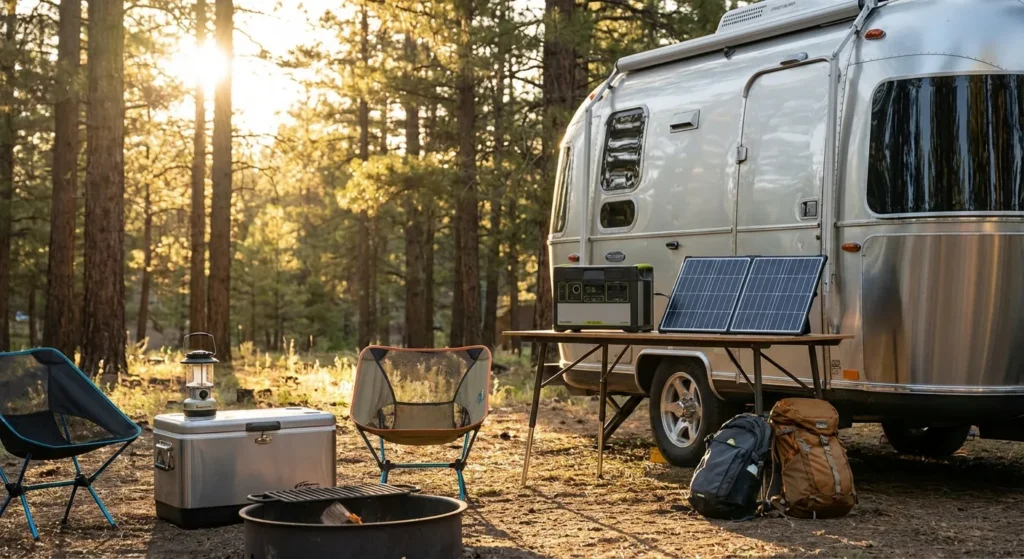
If you’ve ever pulled into a gorgeous boondocking spot only to realize your rig’s house batteries are barely hanging on, you already know the pain. Running a generator at 6 AM will get you dirty looks from every neighbor in a half-mile radius, and honestly, you deserve better than that.
Portable power stations have gotten ridiculously good in the last couple of years. LiFePO4 batteries are the standard now, solar charging is fast enough to actually be practical, and the prices have come down to the point where these things make sense for weekend warriors and full-timers alike. Let’s dig into the best options for keeping your RV powered up off-grid in 2026.
Why Portable Power Stations Beat DIY Generators
Look, gas generators have their place. But for most RV campers, a portable power station is just a better fit. Here’s why:
- Dead silent. We’re talking 30 dB or less. You can run one inside your rig at night without waking anyone up. Try that with a Honda EU2200i.
- Zero fumes. No carbon monoxide worries, no gas cans rattling around in your basement storage, no trips to the gas station.
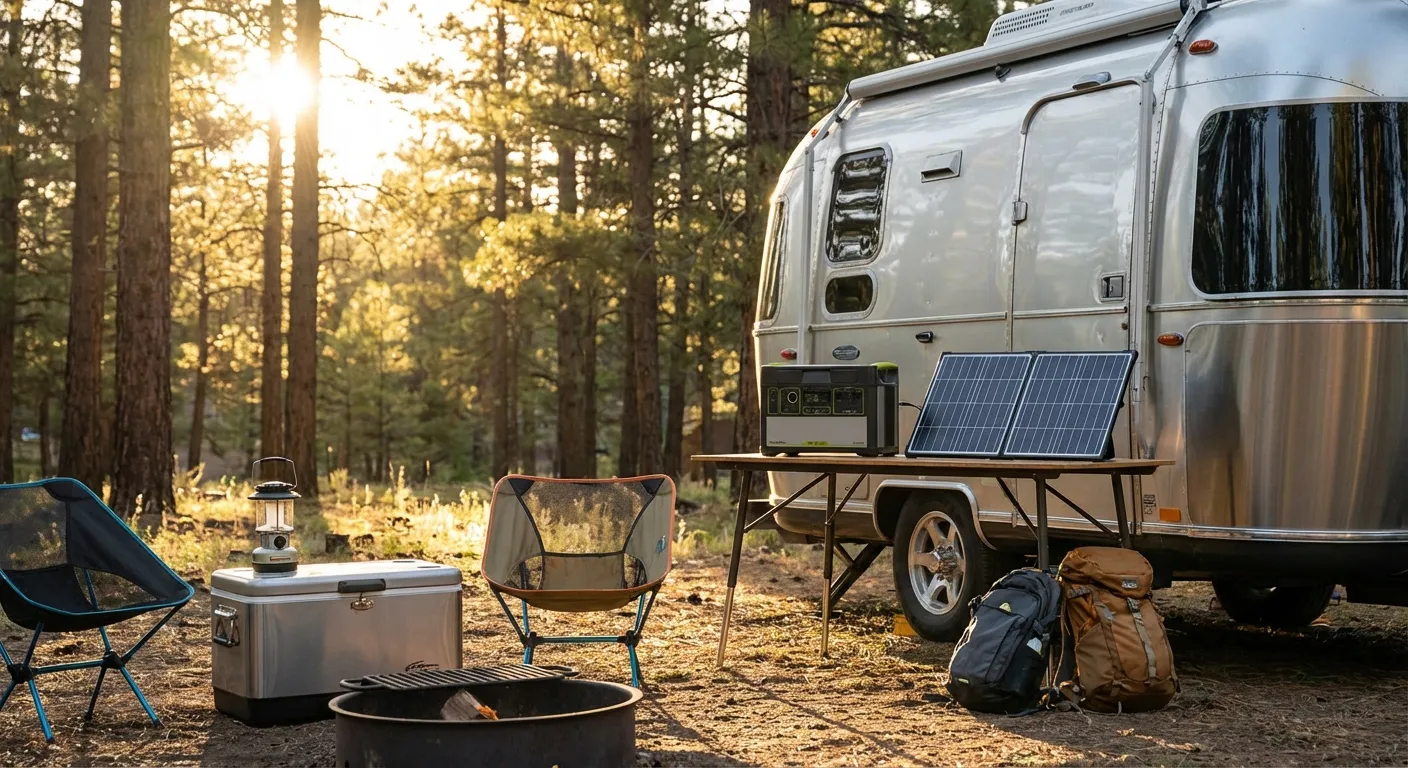
- Solar-ready out of the box. Every modern power station accepts solar panel input. Pair it with a couple of folding panels and the sun literally pays your electric bill.
- Low maintenance. No oil changes, no spark plugs, no carb cleaning after winter storage. Charge it, use it, done.
- Campground-friendly. Many BLM and National Forest dispersed sites have generator hour restrictions. Power stations don’t count as generators because they aren’t.
The trade-off? You can’t run your rooftop A/C for hours on end (at least, not without a massive unit and a lot of solar). But for CPAP machines, fridges, laptops, phone charging, Starlink, and even a coffee maker in the morning, a good power station handles it all without drama.
What to Look For
Before you throw money at the shiniest unit on Amazon, here are the specs that actually matter for RV use:
Watt-Hours (Wh): This is your fuel tank. A 1,000 Wh station will run a 12V fridge for roughly 24 hours, or charge your laptop about 15 times. For weekend trips, 1,000-1,500 Wh is the sweet spot. Full-timers should look at 2,000 Wh and up.
Continuous Wattage (W): This is how much power it can deliver at once. A 2,000W station can run a microwave, a blender, or a hair dryer. Anything under 1,500W and you’ll be picking and choosing which appliances get juice.
Solar Input: Higher solar input means faster recharging. Look for at least 400W solar input capability. The best units accept 800-1,000W, which means a full recharge from panels alone in 3-4 hours.
Weight: You’re going to carry this thing. Under 30 lbs is manageable for one person. Over 50 lbs and you’ll want a cart or a permanent mounting spot.
Battery Chemistry: LiFePO4 (LFP) is the gold standard. It lasts 3,000+ charge cycles versus 500-800 for older lithium-ion. That’s roughly 10 years of daily use. If a unit still uses NMC or standard Li-ion cells, skip it.
Expandability: Some stations let you daisy-chain extra battery packs. If you think you might want more capacity later, this is a huge deal.
Best Overall: EcoFlow DELTA 2 Max
The EcoFlow DELTA 2 Max is the one I’d recommend to most RV campers who want a do-everything power station without going overboard.
Key Specs:
– Capacity: 2,048 Wh (expandable to 6,144 Wh)
– Output: 2,400W continuous (3,400W with X-Boost)
– Solar Input: Up to 1,000W
– Weight: 50.7 lbs
– Battery: LiFePO4, 3,000+ cycles
– Charge Time: 0-80% in 43 minutes (AC + solar), ~1.1 hours AC only
What makes the DELTA 2 Max special is the charging speed. Getting to 80% in under an hour means you can top it off at an RV park between boondocking stretches without planning your whole day around it. The 2,400W continuous output handles a microwave, a coffee maker, or even a small portable A/C unit. X-Boost mode pushes that to 3,400W for brief heavy loads.
The expandability is clutch too. Start with the base unit, and if you realize you need more juice for full-time living, snap on an extra battery and you’re at 4,096 Wh. Two extra batteries get you to 6,144 Wh, which is legitimate whole-RV power.
At around 50 lbs it’s not light, but it’s manageable with the built-in handles. And at 30 dB, it’s quieter than a whispered conversation.
Best Value: Jackery Explorer 1000 Plus
If you don’t need the monster capacity of the DELTA 2 Max, the Jackery Explorer 1000 Plus hits the sweet spot between price, performance, and portability.
Key Specs:
– Capacity: 1,264 Wh (expandable to 5,024 Wh)
– Output: 2,000W continuous (4,000W surge)
– Solar Input: Up to 800W
– Weight: 31.5 lbs
– Battery: LiFePO4, 4,000+ cycles
– Charge Time: ~100 minutes from wall outlet
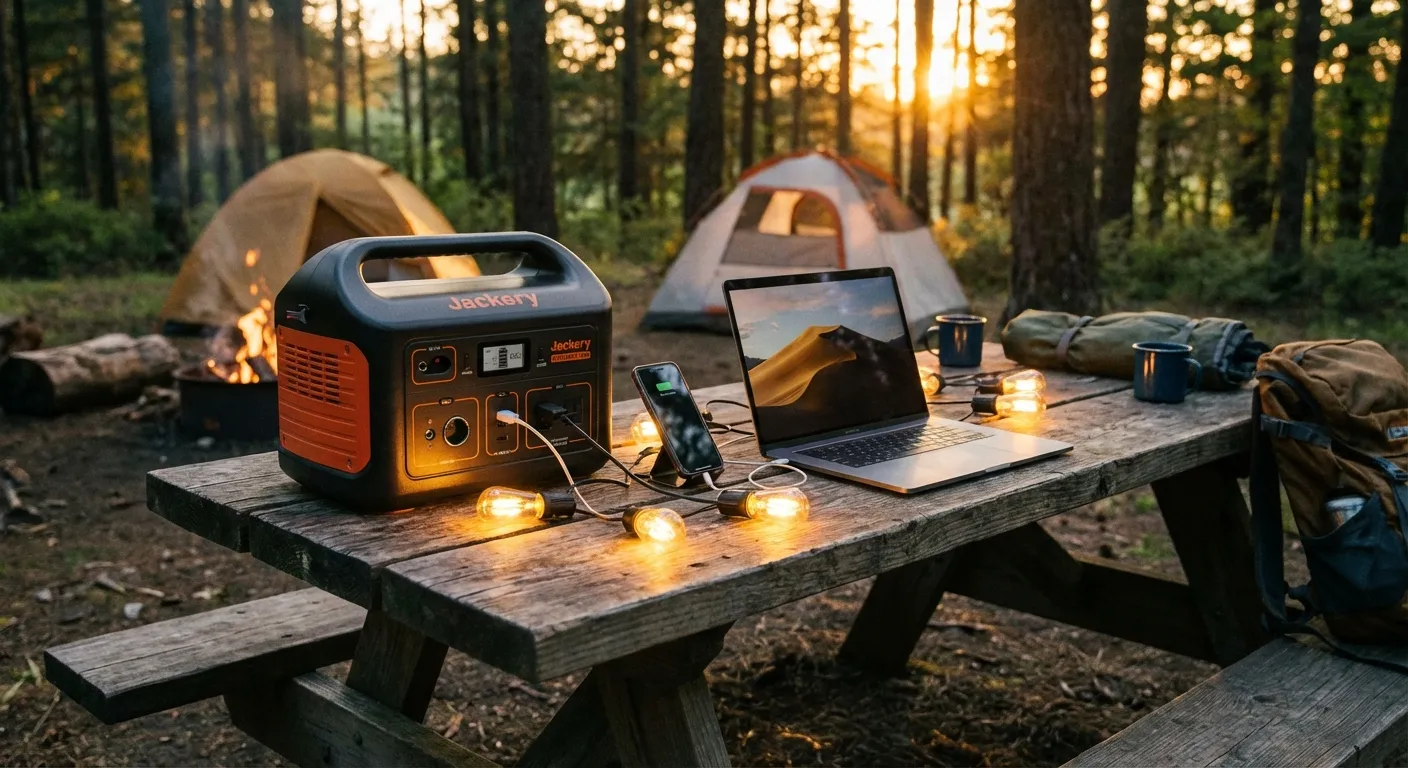
Jackery has been in the portable power game longer than almost anyone, and the 1000 Plus shows that experience. The interface is dead simple – a big clear display, clearly labeled ports, and an app that doesn’t require an engineering degree.
At 31.5 lbs, this is genuinely portable. You can grab it with one hand and carry it from your RV to a picnic table without breaking a sweat. The 4,000-cycle battery rating is actually best-in-class here, meaning this thing will outlast most RVs.
For weekend camping trips, 1,264 Wh will keep your fridge running, your phones charged, your Starlink online, and still have enough left for morning coffee. If you need more, Jackery’s expansion batteries push it all the way to 5,024 Wh.
Best for Full-Time RVers: Bluetti AC200MAX
Full-timers need serious capacity, rock-solid reliability, and the ability to grow the system over time. The Bluetti AC200MAX checks every box.
Key Specs:
– Capacity: 2,048 Wh (expandable to 8,192 Wh)
– Output: 2,200W continuous (4,800W surge)
– Solar Input: Up to 900W
– Weight: 61.9 lbs
– Battery: LiFePO4, 3,500+ cycles
– Ports: 16 total outputs, including 30A RV plug
The killer feature for RVers is that 30A TT-30 outlet and the 12V/30A DC output. You can wire this directly into your RV’s electrical system, which means your existing outlets and switches work normally – your rig doesn’t even know it’s running off a power station instead of shore power.
The expansion potential here is wild. Two B230 or B300 batteries bring you to 8,192 Wh, which is enough to run a small RV’s entire electrical load for 2-3 days without any solar input at all. Add panels and you could theoretically stay off-grid indefinitely (weather permitting).
At nearly 62 lbs for the base unit, you’ll want to find it a permanent home inside your rig. Most full-timers mount it in a basement compartment or under a dinette seat.
Comparison Table
| Feature | EcoFlow DELTA 2 Max | Jackery Explorer 1000 Plus | Bluetti AC200MAX |
|---|---|---|---|
| Capacity | 2,048 Wh | 1,264 Wh | 2,048 Wh |
| Max Expanded | 6,144 Wh | 5,024 Wh | 8,192 Wh |
| Output | 2,400W (3,400W boost) | 2,000W (4,000W surge) | 2,200W (4,800W surge) |
| Solar Input | 1,000W | 800W | 900W |
| Weight | 50.7 lbs | 31.5 lbs | 61.9 lbs |
| Battery Cycles | 3,000+ | 4,000+ | 3,500+ |
| AC Charge Time | ~1.1 hours | ~100 min | ~3.5 hours |
| 30A RV Plug | No | No | Yes |
| Best For | All-rounders | Weekend campers | Full-timers |
Solar Panel Pairing Guide
A power station without solar panels is just a really expensive battery. Here’s how to pair them for actual off-grid independence:
Match your solar input to the station. The DELTA 2 Max accepts up to 1,000W solar, so two EcoFlow 220W panels (440W total) will recharge it in about 5 hours of good sun. Four panels get you closer to 3 hours.
Brand matching matters (sometimes). Jackery’s SolarSaga 200W panels use proprietary connectors that work seamlessly with the Explorer 1000 Plus. Bluetti’s PV200 panels are designed for the AC200MAX’s input specs. Mixing brands usually works with adapter cables, but you lose the plug-and-play simplicity.
How many panels do you need? A good rule of thumb:
– Weekend trips: 200-400W of solar keeps you topped off
– Extended boondocking (1-2 weeks): 400-600W ensures you can replenish daily use
– Full-time off-grid: 600W+ and you’ll rarely worry about power
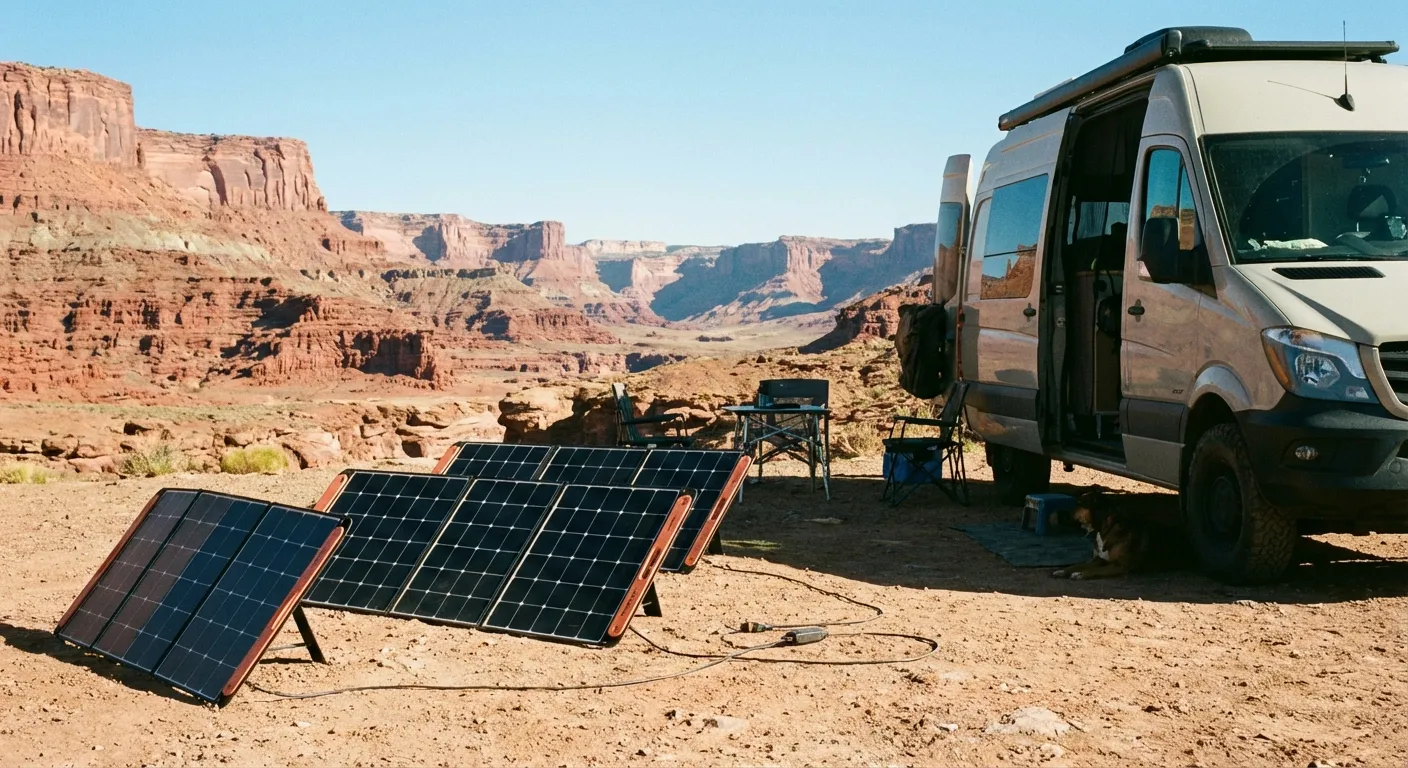
Placement tips: Angle panels toward the sun (not flat on the ground), clean them regularly, and remember that even partial shade on one cell can tank the output of the whole panel. A long cable extension so you can put panels in the sun while your RV stays in the shade is worth every penny.
FAQ
Can a portable power station run my RV air conditioner?
Short answer: kind of. A typical RV rooftop A/C pulls 1,200-1,500W while running and surges to 2,500-3,000W on startup. The DELTA 2 Max and AC200MAX can handle the surge, but a 2,048 Wh battery will only run the A/C for about 1-1.5 hours. For overnight cooling, you’d need serious expansion batteries and very strong solar the next day. Most boondockers use a 12V fan or portable evaporative cooler instead.
How long will a power station run my CPAP machine?
A CPAP typically draws 30-60W depending on pressure settings and whether you use a heated humidifier. On the Jackery Explorer 1000 Plus (1,264 Wh), you’re looking at 20-40 hours of runtime – easily multiple nights on a single charge. This is honestly one of the best use cases for portable power stations.
Is it worth buying solar panels, or should I just recharge at campgrounds?
If you boondock more than a few times a year, solar pays for itself fast. A campground with hookups runs $30-50/night in most places. Two or three weekends of boondocking with solar instead of paying for hookups and you’ve covered the panel cost. Plus, you’re not tied to campground reservations, which in 2026 is half the battle.
Can I charge a power station while driving my RV?
Yes. All three stations in this guide can charge from a 12V vehicle outlet, though it’s slow (usually 100-200W). For faster charging on the road, some RVers wire a dedicated circuit from their alternator to the power station’s DC input. The EcoFlow and Bluetti units also support simultaneous charging from multiple sources, so you can trickle-charge from the vehicle while also pulling from a panel on the roof.
Portable power stations have completely changed the boondocking equation. What used to require a noisy, smelly generator or a complex DIY battery bank now fits in a box with a handle on it. Whether you’re a weekend warrior who wants to keep the fridge cold and the coffee hot, or a full-timer chasing sunsets across BLM land, there’s a station on this list that fits your setup and your budget.
Grab some solar panels, find a spot with a view, and let the sun do the work. That’s what off-grid camping is supposed to feel like.