

You’re fifty miles from the nearest town, parked on BLM land with no hookups, and your phone buzzes: fresh water tank at 18%, battery bank dropping faster than expected, and the inside temp just hit 94 degrees while your dog is napping in the rig. That notification just saved your trip — and maybe your pet’s life.
Remote RV monitoring has gone from a nice-to-have luxury to something most serious RVers consider essential gear. Whether you’re a weekend warrior or a full-time boondocker, the combination of the right app and a handful of smart sensors turns your rig into something that actually talks back to you. Let’s break down what’s worth your money in 2026.
Why Remote RV Monitoring Matters in 2026
The RV lifestyle has shifted hard toward off-grid camping, and with that comes a real need to keep tabs on your rig when you’re away from it. Pet safety is the number one driver — leaving a dog in an RV without temperature monitoring is a gamble nobody should take. But it goes beyond pets. Battery health, propane levels, tank capacity, and tire pressure all affect whether your trip ends with a sunset or a tow truck.
The tech has caught up, too. Bluetooth sensors are cheaper and more reliable than ever. Cellular monitoring means you don’t need campground Wi-Fi. And the apps have matured from clunky dashboards into genuinely useful tools that send you alerts before small problems become expensive ones.
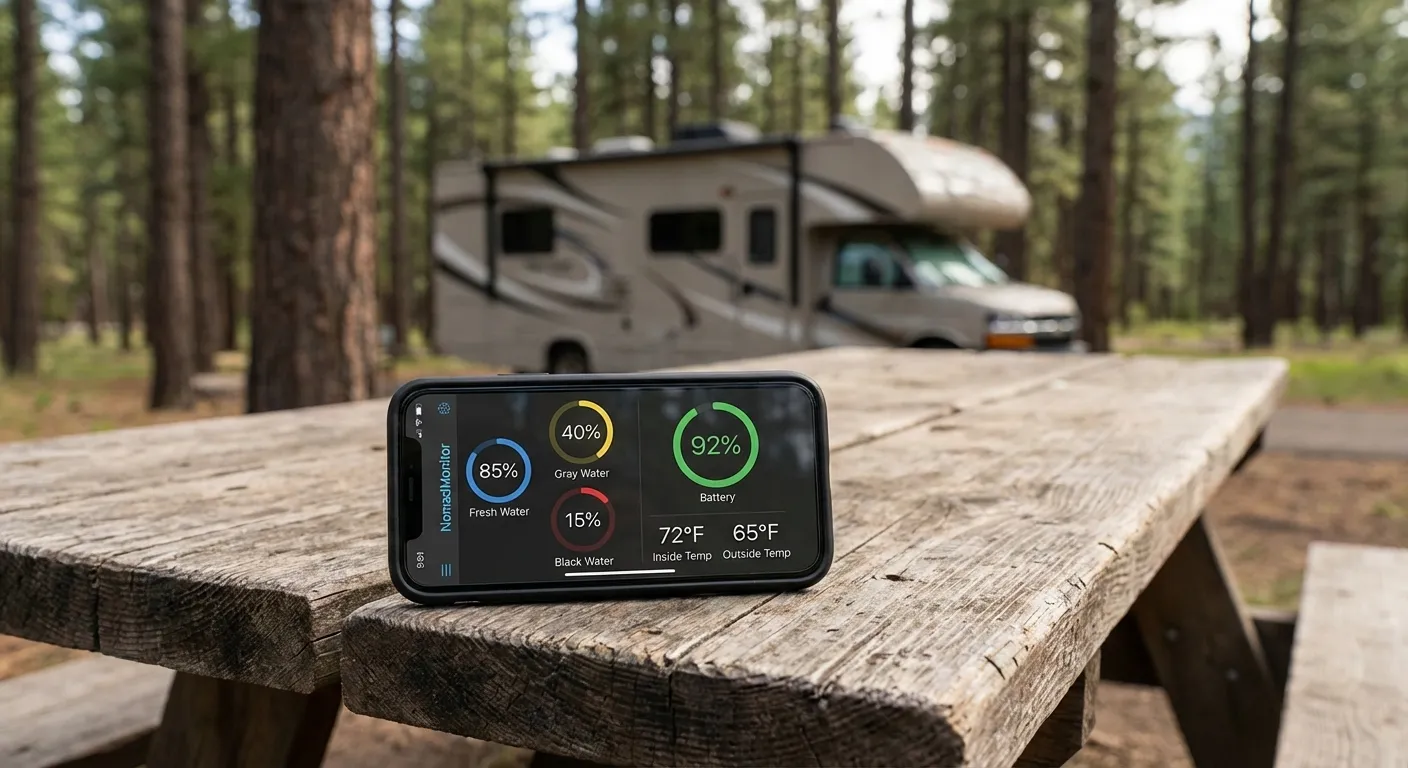
Best RV Monitoring Apps
Lippert OneControl
If your RV was built in the last few years by a major manufacturer, there’s a good chance it already has OneControl hardware baked in. The app handles leveling systems, slide-outs, awnings, lighting, HVAC, tank levels, and battery status — basically everything wired into your rig’s control system. The ConnectAnywhere 2.0 feature with a telematics plan adds true remote access from anywhere with cell service. It also supports aftermarket accessories like TPMS sensors, propane monitors, and smart locks. Free to download, though the telematics plan runs extra for remote connectivity.
Best for: RVers whose rigs already have Lippert hardware installed.
RV Whisper
RV Whisper is the scrappy underdog that full-timers love. It’s a small monitor station that lives inside your RV, collects data from wireless Bluetooth sensors, and stores everything locally on a micro SD card. Connect it to Wi-Fi and you get remote access plus email and text alerts. It monitors temperature, humidity, shore power, battery voltage and current, propane, tire pressure, fresh/grey/black tank levels, door sensors, water leaks, and motion — basically the whole rig. The hardware costs around $300-400 depending on your sensor package, and after the first year of included alert monitoring, it’s $42 per year. Customer service gets consistently great reviews, which matters when you’re troubleshooting from a campsite in Montana.
Best for: Full-timers and boondockers who want comprehensive, independent monitoring.
BMPRO RVMaster
BMPRO’s Australian engineering has made serious inroads in the North American market. Their RVMaster system uses a combination of Bluetooth and CAN Bus technology (including the RV-C protocol) to give you app-based control over lighting, slide-outs, awnings, HVAC, generators, and all your monitoring sensors. The ProSmart add-on sensors cover tire pressure, temperature, and propane. The system is modular, so you can start basic and scale up over time. BMPRO systems are showing up as factory installs in several Jayco models (branded as JayCommand), which is a strong vote of confidence.
Best for: Folks who want a modular system they can grow into.
Necto 3-in-1
If your primary concern is pet safety or you want dead-simple cellular monitoring without fussing with Wi-Fi, Necto is worth a hard look. Their 3-in-1 sensor monitors temperature, humidity, and power status over built-in 4G LTE — it automatically selects the strongest available network. No hub, no Wi-Fi dependency. It just works. The monthly cellular plan adds ongoing cost, but for pet owners who boondock, the peace of mind is tough to beat.
Best for: Pet owners who need cellular monitoring without Wi-Fi dependency.
Must-Have Smart Sensors for Your RV
No matter which app or platform you choose, certain sensors earn their keep on every trip.
Temperature and Humidity: The SensorPush HT.w is a compact, water-resistant sensor with solid Bluetooth range and 45 days of onboard data logging. Accuracy sits at plus or minus 0.36 degrees Fahrenheit, which is more than enough for RV use. Stick one inside the rig and one in your basement storage compartment.
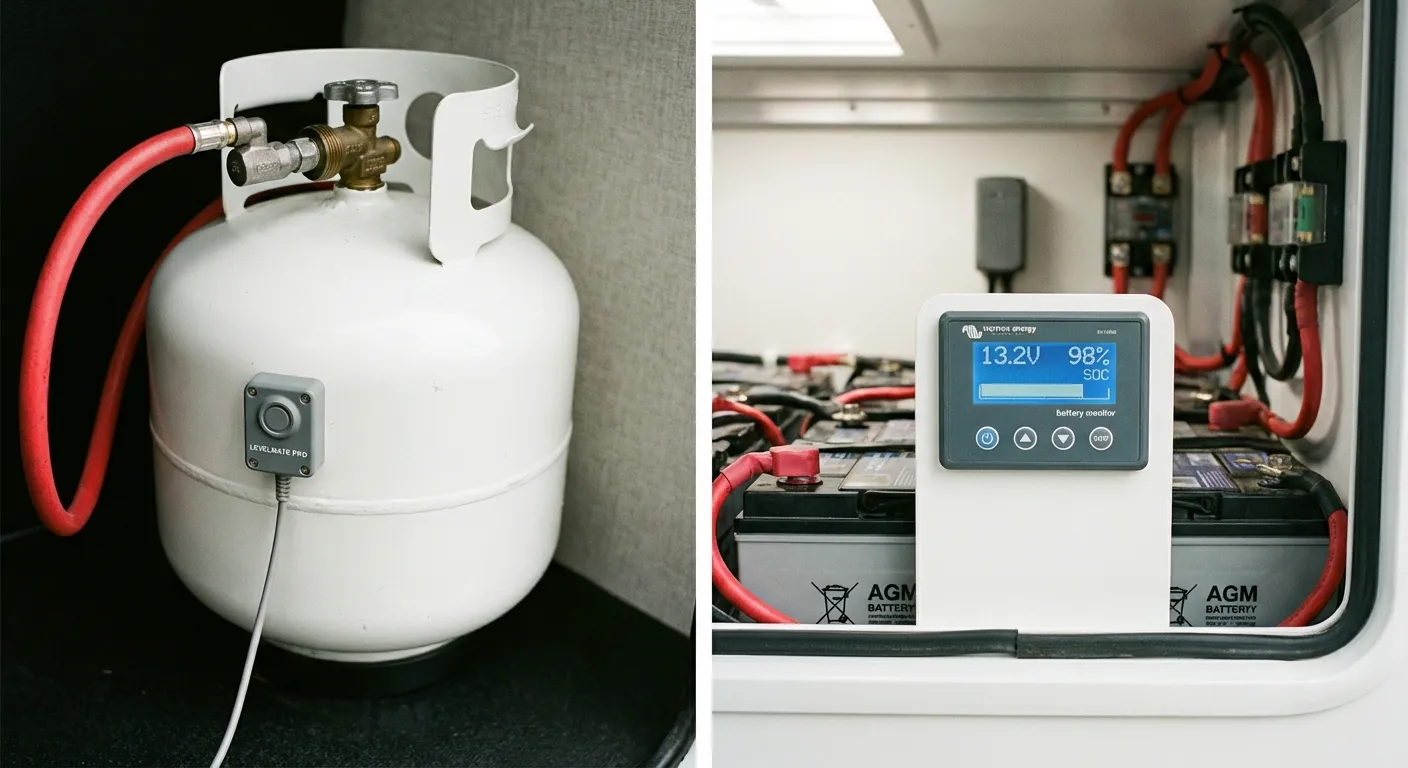
Propane Level: The Mopeka Pro Check magnetically attaches to the bottom of your propane tank and uses ultrasonic sensing to beam the exact fill percentage to your phone. No more guessing or lifting tanks to feel the weight. If you run dual tanks, grab the two-sensor bundle with an LED display for a quick visual check without pulling out your phone.
Battery Monitoring: The Victron BMV-712 Smart is the gold standard for RV battery monitoring. It tracks voltage, current, state of charge, and time remaining with precision that cheaper monitors can’t touch. Built-in Bluetooth connects to the VictronConnect app, and it plays nicely with solar charge controllers and inverters in the Victron ecosystem.
Tire Pressure: A good TPMS system catches slow leaks and heat spikes before blowouts happen. Both OneControl and RV Whisper support TPMS sensors, and standalone systems from brands like TireMinder integrate with most monitoring setups.
Radar Tank Sensors vs. Traditional — Why Upgrade
If you’ve ever stared at your RV’s built-in tank level gauge showing “2/3 full” when you know the black tank is nearly empty, you understand the problem. Traditional resistive sensors sit inside the tank, and they get coated with buildup over time. The readings become essentially fiction.
Capacitive sensors like the Garnet SeeLevel II were the first real improvement. They mount on the outside of the tank and measure capacitance changes through the wall. Much more reliable, and the SeeLevel II has been a trusted name in the RV community for years.
The newest leap is radar-based sensing. Fathom Radar mounts a small radar unit on top of the tank externally, measuring fluid levels to within 0.25 centimeters. No contact with tank contents, no degradation over time, and it works across fresh, grey, and black water tanks. Fathom is currently rolling out through RV manufacturers as an OEM option, so look for it in 2026 and 2027 model year rigs. Simarine also offers a radar tank level sender that’s compatible with NMEA 2000 setups and includes Bluetooth for direct app monitoring.
The upgrade path is clear: if your factory sensors are giving you garbage readings, SeeLevel II is a proven retrofit. If you’re buying a new rig, ask whether radar sensors are an option.
Setting Up Your Smart RV Dashboard
Getting all these sensors talking to one app is the dream, but reality usually involves two or three apps. Here’s a practical approach:
Start with your platform. If you have OneControl or BMPRO hardware, use that as your foundation. It handles the big stuff — leveling, slides, HVAC, and built-in tank sensors.
Layer in standalone sensors. Add SensorPush for precision temperature monitoring, Mopeka for propane, and Victron for battery data. Each has its own solid app.
Set alerts aggressively. Configure push notifications for temperature extremes (above 85 or below 35 degrees inside the rig), battery voltage below 12.0V, and propane below 20%. You want to know about problems before they become emergencies.
Consider a tablet mount. A dedicated tablet running your primary monitoring app, mounted near the entry door, gives you a quick-glance dashboard every time you walk in. Some RVers use an old iPad for exactly this purpose.
What’s Coming Next: AI Diagnostics and 5G
The next wave of RV monitoring is going to feel like a jump. Several manufacturers are building AI-powered diagnostic layers on top of sensor data — think pattern recognition that tells you your battery is degrading before it fails, or that your water usage pattern suggests a slow leak you haven’t noticed.
5G connectivity is expanding into rural areas, which means cellular monitoring will get more reliable in exactly the remote places where RVers need it most. Starlink integration for RV monitoring dashboards is already being discussed in the full-timer community.
Expect to see more unified platforms, too. The current reality of juggling three or four apps per rig is a pain point every manufacturer knows about, and the RV-C communication protocol is making cross-brand sensor integration more practical.
FAQ
Do I need Wi-Fi for RV monitoring?
Not necessarily. Cellular options like Necto work over 4G LTE with no Wi-Fi required. Bluetooth sensors like SensorPush and Mopeka work directly with your phone when you’re in range. For true remote monitoring from anywhere, you’ll need either Wi-Fi (RV Whisper) or a cellular plan.
Can I retrofit smart sensors into an older RV?
Absolutely. Most of the sensors mentioned here — SensorPush, Mopeka, Victron BMV-712, and SeeLevel II — are designed for aftermarket installation. None of them require cutting into tanks or running complex wiring. Budget two to four hours for a full sensor suite install.
What’s the best RV monitoring setup for pet safety?
A cellular temperature monitor like Necto is the most reliable option since it doesn’t depend on campground Wi-Fi. Pair it with a SensorPush HT.w as a backup that logs data locally. Set temperature alerts at 80 degrees Fahrenheit so you have time to respond before conditions become dangerous.
How accurate are propane tank sensors?
Ultrasonic sensors like the Mopeka Pro Check are accurate to within about 5% of tank capacity in real-world use. That’s dramatically better than the old float-gauge style indicators, and more than precise enough to plan your refill stops.